Friday, November 11, 2016

A Reading List for Emerging Leaders

One week ago, I had the privilege and honor to attend and speak at the annual mcn.edu conference in New Orleans, LA.
The MCN community is remarkable: welcoming, supportive, energetic, positive, open and the organization itself is entirely volunteer-driven. For me it is a deeply-valued and important group of colleagues from whom I am continually learning. I was so happy to be there and honored to be selected as a presenter.  

One of the topics that I wanted to focus on, and one I'd like to continue to support and drive to success, is the development of new leaders in our sector. From within the MCN community and across the cultural heritage sector, that's likely to be the next wave of CIOs, CTOs, Chief Digital Officers, and (hopefully, eventually) Executive Directors. I participated in a couple of sessions that focused on career development, and after one such session I saw this tweet:


Chris was responding to a few things I had been mentioning that I'd read which had been valuable in forming my theory and practice of leadership. My twitter reply was:


Therefore, I am going to fulfill that promise. But first, a caveat:

Dear Reader,
Please note that this list of resources on leadership is not - nor could it be - comprehensive. I have learned so much over so many years, and I'll never be able to recall every book, article, blog post or conversation that contributed to what I've managed to remember and apply. Also, while I strive to be a good leader and work on it constantly, I make no proclamation of expertise or wisdom. I'm a work in progress, what I try to do is improve consistently over time. Finally, I'm certain this list will suffer from the Recency Effect, and thus reflect primarily the things I've been reading *lately* that have had an impact on the way I approach my role.

All of that being said, here we go:

Ari Weinzweig
A Lapsed Anarchist's Approach to Being a Better Leader

This book, written with intelligence and humility plus a dose of humor, has been a wonderful and validating read for me. It brings together the servant leadership model with the spirit of human independence and agency - as expressed via Anarchism (but not Anarchy, which is ... well, read the book, he explains it better than I can). 
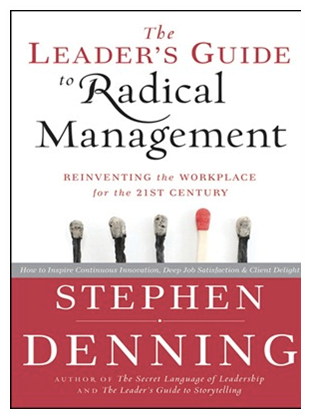


Stephen Denning
The Leader's Guide to Radical Management

While I am actually on a mini-crusade to ban the word "management" from our collective vocabulary, I learned a lot from this book about being truly open and transparent as a leader, and about the concept of "servant leader". While not a specific recommendation from the book, it helped inspire me to share my own performance evaluation results with everyone on my team. I believe that kind of radical transparency builds trust.


Mark Murphy
Hiring for Attitude

I admit to mixed feelings about this book - at times it comes across too much like a sales pitch for the author's consulting firm. That being said, if you ignore those paragraphs, this book will help you determine and implement a truly effective way to hire the right people for the right reasons - and especially how to conduct interviews to find them from among your pool of applicants. I make no bones about it: hiring the right people is a leader's number one priority. Knowing how to do this right will set you on a path to success.


Joel Spolsky
Smart & Gets Things Done

Oh no, another book about talent strategy! Trust me, not only is that your first priority, but this book (even with it's healthy dose of snark) will motivate you never to accept mediocre. While Mr. Spolsky's recommendation that top software developers get the corner office is an unlikely outcome in the cultural heritage sector, this book will offer useful tips on finding and keeping stars.


Carol Dweck
Mindset: The New Psychology of Success

Dr. Dweck lays out an effective argument about the deep impact of mindset on the ability of people to make change and work hard to overcome obstacles. At the core of this is the difference between the fixed mindset and the growth mindset: the first assumes that talent is innate and effort relatively pointless; the second that hard work and continuous learning + a deep sense of optimism will win the day. Probably not hard to guess that I agree with the latter! 


Eric Reis
The Lean Startup

I've met plenty of entrepreneurial types who consider this book a sort of bible. While I wouldn't go that far, I do find inspiration in Reis' perspective on running fast with practical resource limits - sounds pretty familiar for the non-profit sector IMHO. Like a lot of other resources on this list, this book will point to several others that will be of use to you as you grow into your role as a 21st century leader. 


The Harvard Business Review

I can imagine that some of you are wondering if I've lost my mind on this one. Harvard Business Review? I might as well be recommending the Wall Street Journal! Well, actually, that might be on the next list. Why? Look - I understand that most of my readers are from the non-profit, cultural sector. We are not MBAs. But perhaps that actually increases our need to learn about how the business sector conceives of and implements leadership models. Not every issue of this (rather expensive) magazine will add directly to your leadership knowledge, but the access to their deep archive that comes with the subscription is well-worth that cost.   Here are some of the reprints you'll want to dig up and dig into right off the bat:

The Work of Leadership R. Heifetz and D. Laurie (Dec 2001)
The Passive-Aggressive Organization G, Neilson, B. Pasternak and K. Van Nuys (Oct 2005)
Eight Ways to Build Collaborative Teams L. Gratton and T. Erickson (Nov 2007)
Why Teams Don't Work, An Interview with J. Richard Hackman (May 2009)
Accelerate! J. Kotter (Nov 2012)
Building a Game-Changing Talent Strategy D. Ready, L. Hill and R. Thomas (Jan-Feb 2014)


The New York Times Corner Office

Each Sunday, in the Business Section of the New York Times, you'll find a feature called Corner Office. Read it. It's short, often inspiring, and in it you'll see not only what's foremost on the minds of contemporary leaders but almost always some tips about how they look at talent strategy. Then you can go do the crossword!


Jim Whitehurst
The Open Organization

At Redhat, they operate as an open organization, breaking down silos and hierarchies so that only the best ideas get implemented - no matter who came up with them. This bold approach, as told from the perspective of an executive who joined the organization without ever working in such an environment, results in a workplace that is energetic, intense and often filled with debate. Not for the weak of heart, but really interesting. 


Blogs and Social Media
There seem to be hundreds of Leadership-themed blogs out there. To be honest, I haven't really found one that I feel I can't live without. One of the most-popular in the world is authored by Michael Hyatt (scroll down a bit to the blog link) - I find it a bit self-promotional but many of the posts are spot on. I'm also a fan of Dan Pink's work - his books and his online resources
Sometimes simply perusing Twitter under #leadership yields fascinating rabbit holes that I get lost in for way too much time!

As a parting thought: This topic is on my mind, so I speak and tweet and get interviewed and sometimes write about it myself here on this blog (which I should do with more consistency, I know). I hope you will follow along as you see fit and join in the dialog, we can learn from each other.


Thursday, March 17, 2016

Poor Employee Performance: What Exactly is Broken?

Image source: https://pickfreshfood.files.wordpress.com/2015/01/miller-john-one-rotten-apple-amongst-other-green-apples-e1422640780350.jpg

I am a fan of the Sunday New York Times Business Section feature called Corner Office. In fact, I'm enough of a fan that I often forward the short interview-based articles to my own staff, to emphasize particular points about leadership, workplace culture, interviewing job candidates, and just general business sense.

I admit that I often end up with a stack of these things on the corner of my desk. Occasionally I plow through them and drop most into the recycle bin. As I was doing so recently, the article from in December 2014 featuring Robert Reid of Intacct caught my eye once more.

There is one specific paragraph in that article that really struck me. It reads:

"Almost everyone goes to work to do a good job. And if they’re not doing a good job, most organizations step back and say, “I’m not sure they’re going to make it here.” We think the opposite — that we’ve done something to let them down. We either haven’t taken them through the right process, or trained them appropriately. If somebody is not doing something the way you expect or you have a different viewpoint, you need to seek to understand what’s going on and help them."

This perspective is a quite a shift, both in terms of how to view poor employee performance and how to address it.

I'm working to fold this thinking into my management and leadership style - to reframe the issue from "you are not performing, you are bad and you won't get better, go away please" to "this isn't working and we both know it, so let's figure it out together and take the right steps. If we need to make some difficult decisions, then so be it".

I've also been thinking about Carol Dweck's work over the years regarding the concept of the Growth Mindset. There was an interesting article in the Harvard Business Review November 2014 issue, "How Companies Can Profit from a Growth Mindset", in which she explored the concept and then talked about applying them not only to individuals but also to organizations. In terms of individuals:

Perhaps not surprisingly, as Dweck and colleagues turned their attention to organizations, they found that there was strong consensus about the mindset in each company. While they have not yet measured the impact of mindset on business success (e.g., financial returns), they did find that " ... at a minimum, growth-mindset firms have happier employees and a more innovative, risk-taking culture".

How do we apply these findings and Reid's thoughts on employee performance? 

I'd like to explore this question in four parts: leadership, staffing, success and failure.

Leadership: How organizations view leadership & management, depending on mindset
Leaders:
Fixed Mindset
Growth Mindset
Are responsible for
The organization and its systems
People
Need to
Make assignments
Define Purpose
Seek
Compliant subordinates
Followers (a voluntary choice)
Each day
Monitor performance
Share & inspire
Motivate by
Carrot or stick
Enabling & empowering
View staff as
Needing to be controlled (except Stars, who are privileged)
Needing to be trusted and unleashed
Risks
Are to be avoided or minimized
Are a natural part of the process

Staffing: How organizations approach hiring and evaluating employees

Fixed Mindset
Growth Mindset
Skills
Long list of required skills. Past experience & credentials are most important.
Necessary skills are simply prerequisites, and the list is relatively short
Interviewing
Like a quiz - lots of questions, most have right/wrong answers
Open-ended and conversational, using active listening and curiosity
Interviewers
Supervisor and HR representative
A varied team, including future colleagues
Evaluating job candidates
Checking off the boxes - does this person have the right pedigree?
Seeking aptitude and potential fit with workplace culture, based on consensus across the interview team
Deciding whom to hire
Usually seek outside talent. Hire the most-qualified from pool of  applicants
Often look to promote from within. Seeking someone with potential and a passion for learning
On-boarding
Rules, policies, signatures
Vision, mission, meeting people
Training
Usually not needed, employee was hired with skills in place already
Actively encouraged and supported
Performance reviews
Focus on completion of assignments and adherence to policies
Focus on collaboration, learning, growing and innovation
Staff tend to
Avoid risk, pursue fewer innovative projects, keep secrets, cut corners
Make suggestions, explore new ideas, take calculated risks
Retention
Expected, because skills and talents have been assigned to the right job
Accomplished by providing a great workplace. It's understood & accepted that some will “learn & leave”

Success: What success looks like according to mindset

Fixed Mindset
Growth Mindset
Management view of themselves
We are skilled at picking the right projects & making sure they get done
We are rewarded when staff succeed; we are becoming better mentors
Management view of staff
We got the right person for the job - that employee  is a star
Capable, dedicated and hard-working - just what we need here
Staff view of management
They are smart and gave me a project well-suited for my talents
I felt empowered to own this project and see it through
Staff view of self
I am smart and talented
I worked really hard on this, and the effort paid off
Conclusions by management
Keep assigning the important projects to our stars
Supporting and empowering our staff leads to results
Conclusions by staff
As long as I succeed, I’m special
This organization believes in me

Failure: What failure or poor performance looks like according to mindset

Fixed Mindset
Growth Mindset
Management view of themselves
We told them what to do, clearly they did not step up; we need to stay the course
We are partly responsible; we did not set the right vision or provide the necessary resources for success
Management view of staff
We got the wrong person for the job, not smart enough
They needed more from us. How could we have helped them more?
Staff view of management
They gave me an impossible assignment, they set me up to fail
They seem eager to help me, maybe it’s going to be all right
Staff view of self
I can’t do this, I don’t know how, I'm probably not qualified for this job - I wonder if they are going to fire me
I really struggled with this one. But I know what I need to learn in order to succeed next time
Conclusions by management
We need to terminate that person and find someone with more talent
We need to be more helpful; let’s get together and sort this out
Conclusions by staff
I will not be successful here, time to look for another job
Even if things don’t always go well, they’ve got my back here
Image source: https://jholverstott.files.wordpress.com/2011/04/square-peg-round-hole.jpg
All of this makes me wonder: can this explain square pegs in round holes? Why is it that some people just never seem to make it in your organization? Using this framework might help illuminate the root causes. For example: if you run a growth mindset organization, and you tell staff that you embrace iteration and failure - but you have staff who are fixed mindset - expect problems. Fixed mindset staff see failure as a personal defeat and proof that they are unworthy. Your enthusiasm for experimentation will sound to them like a trap that will lead to getting fired. Mismatch!

In addition, I think it's important to note that no workplace will be effective simply by hiring an army of sycophants. It's not about mutual admiration; it's about alignment - not only on strategy (where are we going and why?) but it's also about mindset. When both are clicking, I would wager that success is coming.

I'm also a believer in dissension and differences of opinion. I will never forget the lessons of the classic Hans Christian Andersen fairly tale The Emporer's New Clothes.  It's vitally important that you have people on your team who can call BS when they see BS. Furthermore, I believe in the idea of dynamic tension as a driver. In a functional workplace, there is room and encouragement of strong debate - civil and respectful, of course, but strong.

But in a poorly-functioning workplace, conflict and mismatch don't work. I know that it's true that sometimes poor performers need to shape up or ship out. These are hard conversations to have. It's the responsibility of a leader to step up and have them, on adult terms. The fact is that it is not personal, although boy does it feel that way!

There may be a way to turn such discussion into a win-win, if you search hard enough. And I think that's what Robert Reid was getting at.

Poor performers aren't happy, ever, no matter what they may say. There are some basic choices:
Make it better here or find it better elsewhere. If you:
  • Know the workplace culture
  • Know the employee
  • Measure the match between the two
  • Talk honestly and openly about what's happening
  • Explore solutions, together
  • Make decisions on how to move forward, together
Then it's possible to make it a positive outcome for both sides
Good luck in your leadership role, and in facing poor employee performance with courage, compassion, generosity and optimism.

Thursday, March 10, 2016

DAMs in the Nonprofit Sector: From Striving to Thriving


DAMs in the Nonprofit Sector: From Striving to Thriving
This post was originally published on LinkedIn Pulse

Nonprofit organizations compete in the same world and vie for the same customers as any other consumer-oriented business. To be successful, we must be able to engage people in such a way that they will choose to spend their precious leisure time (and dollars) on experiences of culture, the arts and/or social meaning - as opposed to the other options. That's a tall task, especially in a world that offers so many popular alternatives.


The path to success within that competitive landscape is driven in large part by digital content. In order to attract and engage 21st century audiences and contributors, nonprofit organizations have become digital publishing operations, providing access to meaningful content on a scale that was never anticipated. This evolution has been a real challenge for the charities, museums, libraries and archives that serve the public. And like most forms of evolution, it was a test of survival.


Striving

I would argue that over the past decade most nonprofits have become quite adept at producing digital content (such as the high resolution digital photography done in fine art museums, see above). We survived!
That being said, the sector has been playing catch-up when it comes to organizing, cataloging and sharing that content - the core capacities of digital asset management (DAM). Not only is there a large and rapidly-growing body of 'digital stuff' being produced, there is also the cold reality of appropriate budget constraints that limit the sector's ability to invest in technology infrastructure and resources. So our sector continues to strive.
The big question: How can the nonprofit sector move beyond it's current position to one of great success; that is, from striving to thriving?

DAM Matters

Others have written about making the case for DAM, and have even published online questionnaires to help organizations understand their specific needs. After all, " ... a digital file is only a digital asset when it can be easily found and used. Otherwise it’s just another collection of stored bits and bytes."
From my perspective, all organizations need DAM because it's valuable:
  • Significant time and money is spent producing digital media, organizations should maximize the return on that investment.
  • DAM enables efficient publishing processes, which are flexible and support omni-channel strategies.
  • DAM provides a resource across an organization, 24/7, preventing bottlenecks to accessing digital assets (by the way, those bottlenecks are usually people, and those people are generally not so happy about the situation).
  • DAM enables brand consistency across all distribution channels.
  • In some cases, DAM enhances an organization's capacity to manage intellectual property rights and to ensure security of digital assets.
The nonprofit sector (and I'm concentrating primarily on cultural heritage organizations here) must meet additional mandates, which are mission-driven:
      1. Mandate to make Accessible Nonprofit organizations are often supported by public funding and direct donations from citizens. We have a responsibility to share our collections and our knowledge with the public. After all, a museum is really only a warehouse until it opens its doors and invites the public inside to experience its collection. Sharing digital assets - sometimes thought of as digital surrogates - enables an organization to share it's archive widely with the broadest possible audience.
      2. Mandate to Preserve Museums, libraries and archives share a responsibility of stewardship. The public trusts our organizations to take care of our collections, in order to preserve them for the future. In fact, ideally that preservation would last forever - no small task. Not to mention, increasingly the "objects" in the collections are themselves born-digital.
I have written previously about the importance of DAM in our sector, and won't re-hash those points here. In summary, we've simply got to keep working hard in order to move from striving to thriving.

Vision: Thriving

What is the aspirational vision for DAM practice within the nonprofit and cultural heritage sector? Here's my list, which I'm sure is incomplete (please add your thoughts in the comments):
  • As much effort and commitment is put into digital asset management practices and workflows as has been put into production.
  • Re-purposing of existing digital assets is taking place regularly and seen as a humdrum, business-as-usual practice.
  • Digital assets are shared openly, including via linked open data, all of which is driven by automated processes.
  • Standards, for asset production and for asset cataloging-archiving-sharing, are consistently-applied and readily understood across sectors.
  • Nonprofits are able to roll with the shifting sands of publishing workflows - COPE: Create Once Publish Enthusiastically
We can get there, and we'll get there faster by working together.


Gather - Collaborate - Share - Learn

In May 2016, I will be presenting together with several esteemed colleagues - including Julie Shean and Marianne Nouwen - at the Henry Stewart DAMNY Conference. Our session will use an interactive case study format to bring multiple perspectives to the topic at hand. Panelists from both larger and smaller organizations, representing different types of nonprofits, will share their stories. Along the way, we will explore commonalities and unique needs, and we’ll address some of the challenges faced by the nonprofit sector, such as: How do we implement and ensure the adoption of effective DAM tools and practices? How do we deal with complex metadata models? How can we control costs while still achieving our aspirations? By leveraging the power of collaboration, attendees and presenters will learn from each other, gain practical knowledge, expand professional networks, and set the stage for success. I hope you will join us, and add your perspective and energy to the ongoing dialog.

Insider tip: use this discount code when registering to get a great deal on the conference fees:  ARTSMIA100